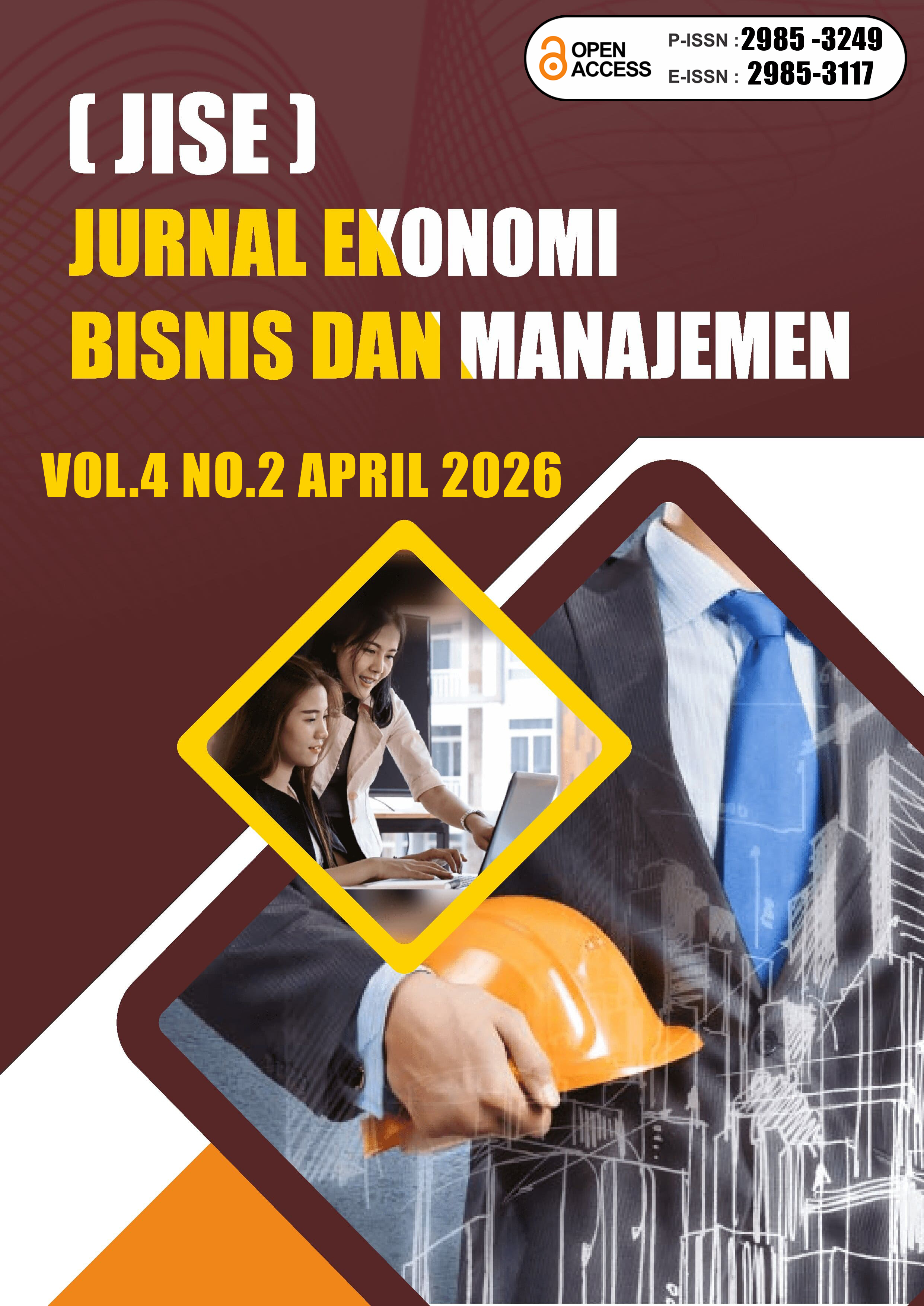
Pengaruh Time Management dan Penggunaan Aplikasi Digital terhadap Efektivitas Belajar Mandiri Mahasiswa STIE Widya Praja Tanah Grogot
DOI:
https://doi.org/10.59024/jise.v4i2.2414Keywords:
Digital Application, Effectiveness of Independent Learning, Higher Education, Self-directed learning, Time ManagementAbstract
This study aims to analyze the influence of time management and digital application use on the effectiveness of independent learning among students of STIE Widya Praja Tanah Grogot. The population consisted of all active students, and the sample comprised 146 students who use digital learning applications, selected through purposive sampling. A quantitative method with a survey approach using structured questionnaires was employed. Data were analyzed using multiple linear regression with SPSS version 26. The results indicate that time management has a positive and significant effect on the effectiveness of independent learning (β = 0.385; p < 0.05), digital application use has a positive and significant effect on the effectiveness of independent learning (β = 0.421; p < 0.05), and simultaneously both variables significantly influence the effectiveness of independent learning with a coefficient of determination (R²) of 0.583. These findings imply that strengthening students' time management skills alongside the optimal use of digital learning applications can improve the effectiveness of independent learning.
References
Britton, B. K., & Tesser, A. (1991). Effects of time-management practices on college grades. Journal of Educational Psychology, 83(3), 405–410. https://doi.org/10.1037/0022-0663.83.3.405
Broadbent, J., & Poon, W. L. (2015). Self-regulated learning strategies & academic achievement in online higher education learning environments: A systematic review. The Internet and Higher Education, 27, 1–13. https://doi.org/10.1016/j.iheduc.2015.04.007
Cazan, A. M. (2014). Learning self-regulation, motivation, and academic achievement in undergraduate students. Procedia - Social and Behavioral Sciences, 191, 155–161. https://doi.org/10.1016/j.sbspro.2015.04.276
Garrison, D. R. (1997). Self-directed learning: Toward a comprehensive model. Adult Education Quarterly, 48(1), 18–33. https://doi.org/10.1177/074171369704800103
Ghozali, I. (2021). Aplikasi Analisis Multivariate dengan Program IBM SPSS 26 (Edisi ke-10). Badan Penerbit Universitas Diponegoro.
Hair, J. F., Black, W. C., Babin, B. J., & Anderson, R. E. (2019). Multivariate Data Analysis (8th ed.). Cengage Learning.
Knowles, M. S., Holton, E. F., & Swanson, R. A. (2020). The Adult Learner: The Definitive Classic in Adult Education and Human Resource Development (9th ed.). Routledge.
Lai, C. (2015). Modeling teachers' influence on learners' self-directed use of technology for language learning outside the classroom. Computers & Education, 82, 74–83. https://doi.org/10.1016/j.compedu.2014.11.005
Macan, T. H. (2022). Time management, perceived control, and college students' academic performance. Journal of Educational Psychology Review, 34(2), 215-231. https://doi.org/10.1007/s10648-022-09654-3
Nugroho, B. S., & Prasetya, D. A. (2023). Pemanfaatan aplikasi digital dalam mendukung kemandirian belajar mahasiswa di era pembelajaran hybrid. Jurnal Teknologi Pendidikan, 15(1), 33-47. https://doi.org/10.21009/jtp.v15i1.4210
Panadero, E. (2017). A review of self-regulated learning: Six models and four directions for research. Frontiers in Psychology, 8, Article 422. https://doi.org/10.3389/fpsyg.2017.00422
Rahmadani, F., & Kurniawan, A. (2021). Pengaruh manajemen waktu terhadap prestasi akademik mahasiswa. Jurnal Ilmu Pendidikan dan Pembelajaran, 8(3), 189-201. https://doi.org/10.26858/jipp.v8i3.5124
Santoso, H., & Widiastuti, R. (2021). Self-directed learning dalam pembelajaran daring: Tinjauan konseptual dan implikasinya bagi mahasiswa. Jurnal Pendidikan dan Kebudayaan, 6(2), 98-112. https://doi.org/10.24832/jpnk.v6i2.2874
Sugiyono. (2022). Metode Penelitian Kuantitatif, Kualitatif, dan R&D (Edisi ke-3). Alfabeta.
van Alten, D. C. D., Phielix, C., Janssen, J., & Kester, L. (2020). Self-regulated learning support in flipped learning videos enhances learning outcomes. Computers & Education, 158, 104000. https://doi.org/10.1016/j.compedu.2020.104000
Wulandari, S., Handayani, T., & Firmansyah, R. (2022). Peran aplikasi pembelajaran digital terhadap efektivitas belajar mandiri mahasiswa perguruan tinggi. Jurnal Manajemen Pendidikan, 10(2), 145-159. https://doi.org/10.21831/jmp.v10i2.4567
Zulkarnain, W., & Anggreini, D. (2023). Digital literacy and self-regulated learning among university students: An empirical study. International Journal of Educational Technology in Higher Education, 20(1), 1-16. https://doi.org/10.1186/s41239-023-00385-2
Downloads
Published
How to Cite
Issue
Section
License
Copyright (c) 2026 JURNAL EKONOMI BISNIS DAN MANAJEMEN

This work is licensed under a Creative Commons Attribution-ShareAlike 4.0 International License.